Asus ZenFone Max M1 Review – Good Phone But Not A Pro!
-

The year 2018 proved to be the most successful year for the Taiwanese smartphone manufacturer ASUS. Starting with Zenfone Max Pro M1 and Zenfone 5Z, it stunned the competitors by announcing budget handsets with decent specs.
The company recently highlighted it by announcing that more than 1 million units of Zenfone Max Pro M1 were sold within 6 months. The ASUS company now announced entry-level budget segment handsets with the unintuitive nomenclature Zenfone Max M1 and Zenfone Lite L1.
Asus Zenfone Max M1 Specifications:
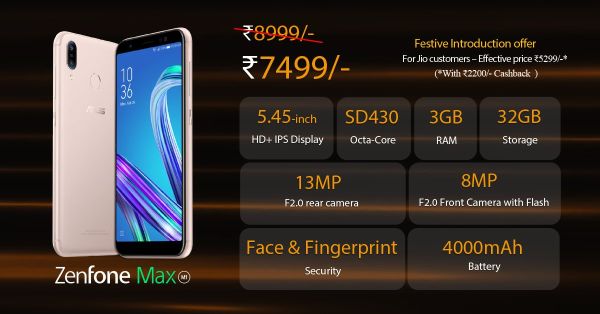
Leaving the nomenclature aside, the new Asus Zenfone Max M1 looks simple and smaller. Design wise, it looks similar to Asus Zenfonre Max M1 Pro. With a resolution of 1440x720 pixels and 247ppi pixel density, the handset has got a decent contrast and colour balance. Though outdoor visibility is good enough it is spoiled by the glass on the top.
The 5.45-inch handset is powered by a decent processor Qualcomm Snapdragon 430 SoC and 3GB RAM. Packed by an inbuilt 32GB storage, the Asus Zenfone Max M1 can be expanded up to 256GB storage via a micro SD card.
Camera & Videography:
Similarly, on the optics front, the primary camera is equipped with 13-megapixel and an 8-megapixel for selfie lovers. The pics are okay in daylight but poor in night photography. Mobile videography is supported with Electronic Image Stabilization. However, one can’t expect great videos at this budget price range.

Powered by a mammoth 4000mAh battery, the Asus Zenfone Max M1 will easily last a little less than a day when compared to Max Pro M1. Due to the absence of a fast charging feature, the handset takes not less than 4 hours for a complete charge. Upon heavy usage, the handset heats up (very common) and is manageable.
The Asus Zenfone Max M1 boots Android Oreo 8.1 based ZenUI 5.0 on the top. On the other hand, the Asus Zenfone Max Pro M1 gives a stock Android experience with a confirmed Android Pie update.
The Asus ZB555KL (code name) is a dual-SIM 4G VoLTE handset with a confirmed provision of dedicated microSD card (triple card) slot. It offers all the required connectivity options including Wi-Fi, Bluetooth, GPS, micro USB port and a 3.5mm headphone jack.
What’s Your Opinion?
Specs wise, the handset can do everything but at a bit slower rate. It can handle pubg asphalt with little tweaks in graphics settings. If you are looking at a decent Snapdragon processor and not interested in Xiaomi phones than it is a better buy.
At a starting price of ₹8999, Asus Zenfone Max M1 is a decent buy. There are a couple of alternatives including Xiaomi Redmi 6 to choose from. On the other hand, if you can stretch the budget then its bigger brother Asus Zenfone Max Pro M1 is a solid performer with Snapdragon 636 SoC.
Also Read: OPPO Realme 1 Gets AI Chip & Dual 4G Support for ₹8990
